

News
Swiss Young Academy SYA
Six new members of the Swiss Young Academy
The Swiss Young Academy (SYA) inducts six new members during its spring Members’ Assembly meeting. This admission follows a selection process during which the early career researchers proved their worth through outstanding scientific achievements, innovative ideas for developing the scientific system, and great interest in and dedication to the interface between science and society. In the next five years, together with existing members, the newly elected researchers will promote inter- and transdisciplinary initiatives and shape the Academy’s activities.
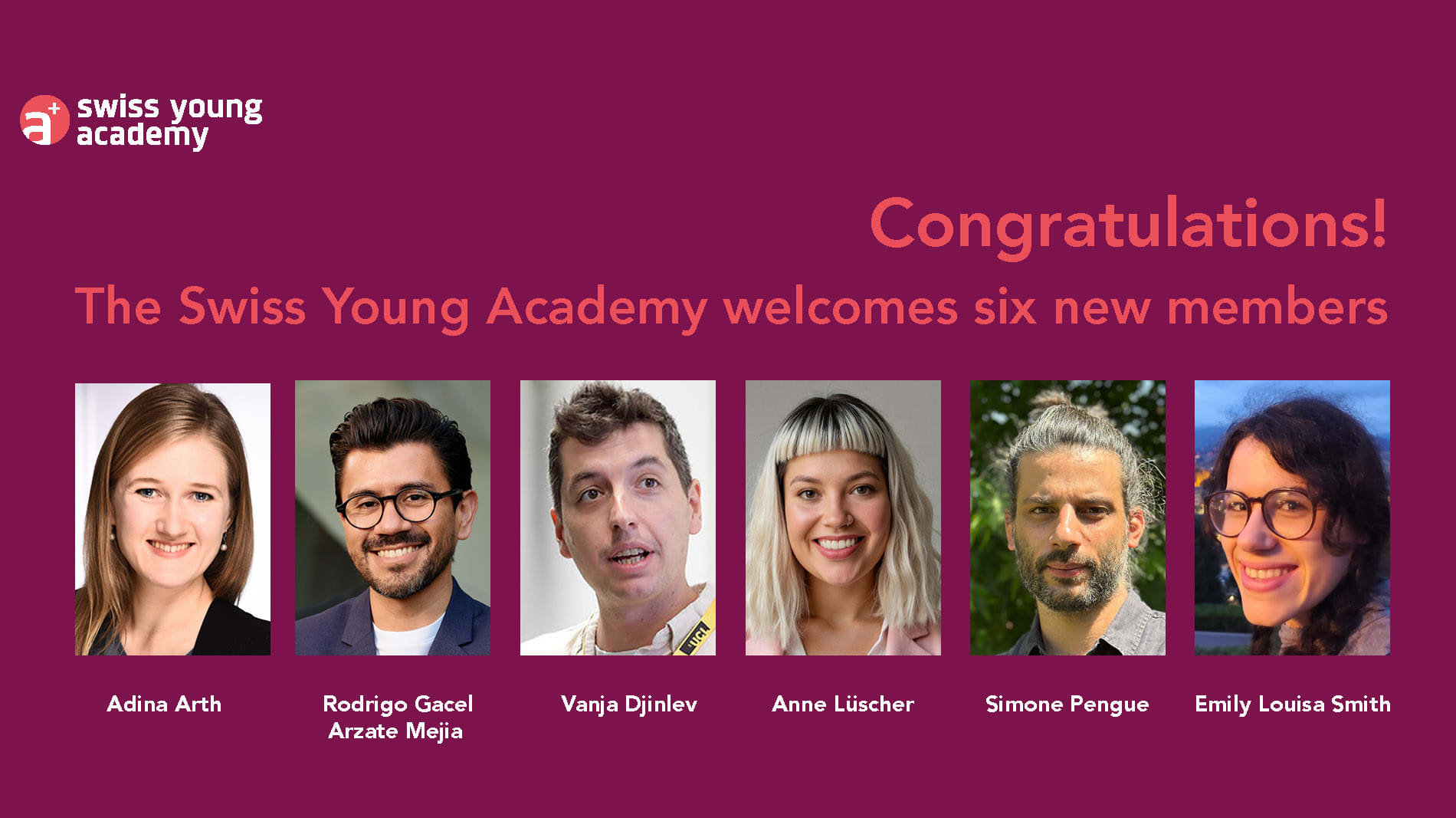
The Election was based on a competitive application process, with a wealth of interesting dossiers from a wide range of scientific disciplines. The applications reflected a broad spectrum of viewpoints and addressed key social and academic challenges. The selection process fell mainly to a broadly based election committee consisting of representatives from the Young Academy and the Swiss Academies of Arts and Sciences, with the election committee drawing up a list of recommendations for the Members’ Assembly meeting. The election was then confirmed by the Board of Directors of the Swiss Academies of Arts and Sciences.
The newly elected members of Swiss Young Academy for 2026–2031 are:
Adina Arth, PhD candidate, School of Management and Law, Zurich University of Applied Sciences (ZHAW) / University of St. Gallen
Rodrigo Gacel Arzate Mejia, Postdoc, Brain Research Institute / Institute for Neuroscience, ETH Zürich / University of Zurich
Vanja Djinlev, Researcher, Swiss Federal Laboratories for Materials Science and Technology (EMPA)
Anne Lüscher, Researcher, arcoris bio AG
Simone Pengue, Scientific journalist, Radiotelevisione Svizzera (RSI)
Emily Louisa Smith, Senior Research and Teaching Assistant, Department of English, University of Geneva
The new members stand out not only because of their scientific achievements, but also because of their vision of science characterised by transparency, inclusion and responsibility. They have a marked interest in and commitment to scientific communication and promoting constructive dialogue between science and society. Furthermore, they contribute innovative ideas on how to develop the scientific system further. On account of their diverse technical backgrounds and personal experiences, the new members will be able to make an important contribution to promoting inter- and transdisciplinary dialogue. When making its selection, the election committee intentionally considered diversity, particularly regarding representation of different language regions and institutional affiliations, in order to appropriately reflect the Swiss scientific system’s structural diversity, whilst simultaneously opening up new opportunities for synergies.
With their membership, the successful candidates gain access to a dynamic network that supports development and implementation of innovative project ideas at the interface between science, society and politics. The objective is to address current social challenges from an inter- and transdisciplinary perspective. As young voices for early career scientists, the members will contribute their points of view directly to relevant discussions and help to develop the scientific system. The Swiss Young Academy furthermore offers opportunities to develop personal projects, a mentoring programme and a variety of opportunities for national and international networking.
Finally, the election committee members would like to thank all the applicants for the high standard of submissions and their interest.