

Blog
Swiss Young Academy SYA
Emmanuel Senft works at the interface between people and robots
Emmanuel Senft has fulfilled a childhood dream: he develops and researches robots. Through the Swiss Young Academy, he works to ensure that artificial intelligence enriches scientific thinking – without replacing the process of discovery itself. And to make the academic system fairer.
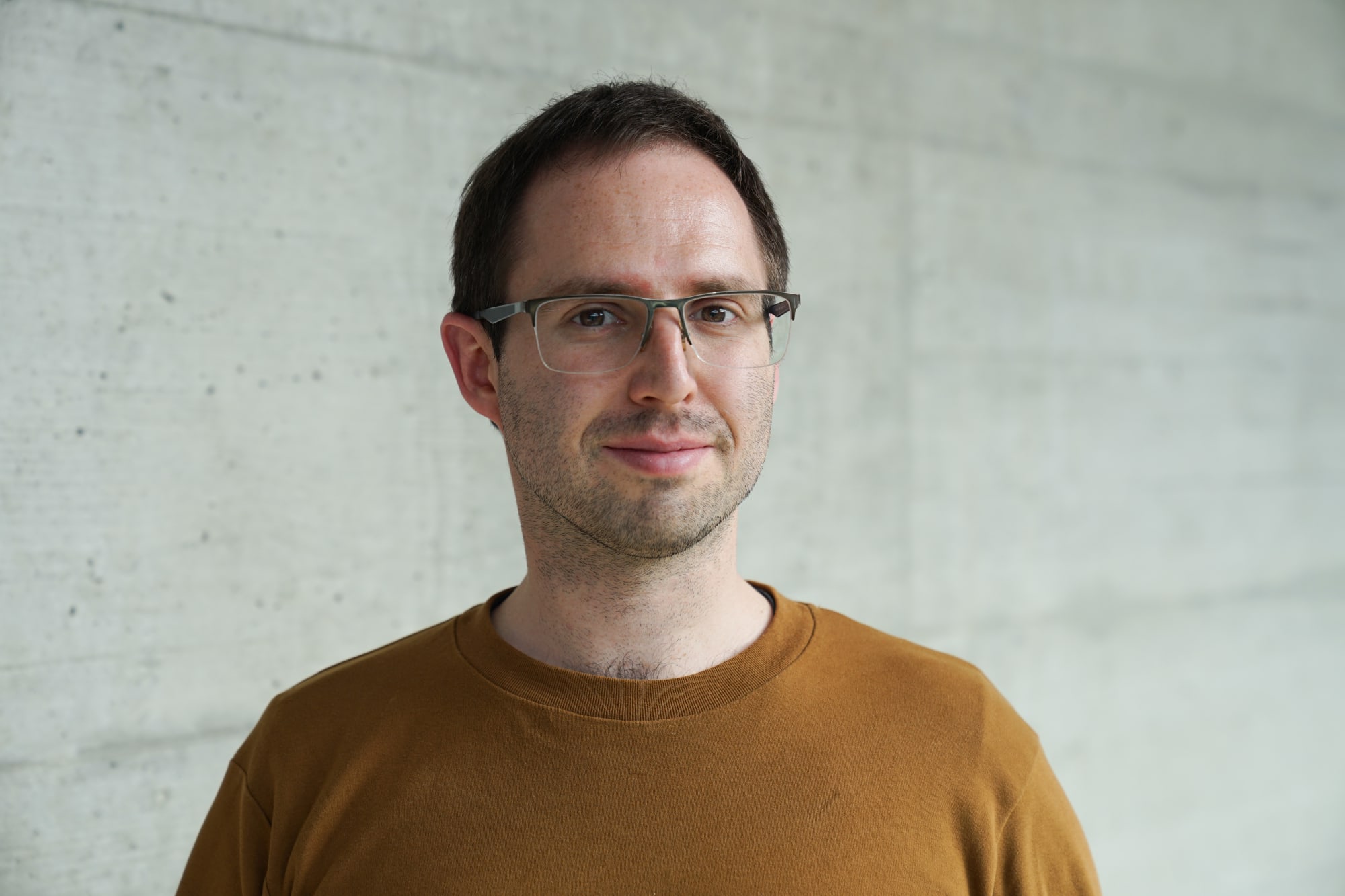
Portrait: Astrid Tomczak
Once upon a time, there was a little boy who grew up in Bons-en-Chablais, a French town not far from the Swiss border, within sight of the Valais mountains and Lake Geneva. Maybe that’s why, for many years, the boy’s Christmas wish list included something that stood in stark contrast to his picture-postcard idyll: a robot. Machine versus nature. He was never given one.
This little boy has since grown into a man, and his childhood dream has become the subject of his research. Emmanuel Senft studied microengineering at the EPFL before specialising in robotics. His PhD took him to Plymouth, in England, where he focused on social robotics and artificial intelligence. The main theme of his dissertation was how to balance a robot’s autonomy and control by a human supervisor. This research was embedded in a European project, and led to the development of robots designed to support therapies for children with autism.
Important rules
This was typical of Emmanuel Senft. He wants to know not only what’s technically feasible, but how humans and machines interact with one another. He recalls the first time he heard about a doll that could use AI to talk to children. “It made me worry about the potential for manipulation,” he says. And not without reason. Research shows that physically present robots are more persuasive than purely digital systems. Concern may be a poor guide, but the experience motivated Senft to examine the risks and responsibilities associated with developing ‘intelligent’ machines designed to interact with humans. At the SYA, he has found a place where he can explore such questions together with other up-and-coming researchers. “I liked the idea of building bridges between science and society,” he says. He considers the SYA the first step “towards making a greater impact beyond pure research”. What drives him is not so much a fear of artificial intelligence itself, “but of the people who misuse it”. That’s why he urges a detailed review of the regulatory framework.
This is particularly evident in the AI in Science and Society project, which Senft is working on with other members of the SYA. Together, they are studying how AI is transforming research, teaching, science communication and political decision-making processes, and what opportunities and challenges this presents, particularly for young researchers (see the publication here). Ultimately, they want to determine the long-term impact of these technologies on the scientific system. Senft believes that the answer is ambivalent: AI can indeed facilitate many things, such as summarising literature, highlighting connections and speeding up processes. But this greater efficacy comes at a price. “You can take a shortcut, but then you miss out on the journey,” he says. By “journey” he means the thought process that leads to insight. The results can be useful, even if you shorten the path to them. But they’re sometimes harder to understand. This raises a fundamental question: when are ‘useful’ results good enough – and when is it crucial that you find your own way there?
A critical look at academia
Probably all young researchers want to beat their own path. However, they must overcome many hurdles along the way. And the scientific system itself creates some of these. This is precisely where a second SYA project comes in. It’s called Innovative Policies for Fostering Academic Careers. Senft describes the academic world as a pyramid. “It’s crazy,” he says. What he means is that the structure of the system forces a significant proportion of up-and-coming scientists to leave academia. What’s more, if individual professors can act as ‘kings governing alone over their own kingdoms’, assuming every role and shaping the next generation as they see fit, the system deserves to be questioned. Does research really have to be organised into large groups? Does it make sense for the same person to be expected to conduct research, teach, manage and communicate, all at the same time? “Just because you’re good at research, it doesn’t mean that you’re good at teaching or leading a team,” Senft explains.
He himself appears to be a born communicator. He speaks quickly, but makes sure his message gets across – even though he mainly communicates in English at work rather than in French, his mother tongue. “My English is far from perfect,” he admits. “But it’s adequate.” To pursue the analogy, the language in which he speaks is comprehensible, i.e. ‘useful’. But what he says goes far beyond that. What Senft loves about his work is meeting people from a wide variety of fields. “One day, I might be talking to an ethicist who specialises in technology, the next perhaps to a sociologist, the day after that, to people from organisations for people with disabilities.” His goal always remains the same: “I talk to people to understand what their actual needs are,” he says. “Only then can we develop the technology.”
Back to his roots
He’s also taking this approach in a project that’s taking him back to his roots. Senft is currently working at the Idiap Research Institute in Martigny, collaborating with physiotherapists to develop robots that support treatment by guiding patients through exercises or helping healthcare professionals during therapy. He knows from his own background what challenges such professionals face: both of his parents are physiotherapists. So too is his brother. He has therefore come full circle: the child that wanted a robot for Christmas has grown up to become a researcher who builds machines not for their own sake, but to put them to use in ways in which they can make a real difference to people’s lives.
Emmanuel Senft (born 1991) grew up in the French town of Bons-en-Chablais, near the Swiss border. After completing his secondary education in France, he studied microengineering at the EPFL in Switzerland and obtained a PhD in human-robot interaction from the University of Plymouth in England. This was followed by language-study and research visits to China and Japan, as well as a postdoctoral fellowship at the University of Wisconsin–Madison in the United States. Since 2022, Senft has headed the Human-centered Robotics and AI research group at the IDIAP Research Institute in Martigny, Switzerland. He works to promote responsible development of AI and robotics. Through the SYA, he aims to bridge the gap between science and politics, create fairer conditions for up-and-coming researchers, and study the effect AI has on research. Having grown up between mountains and a lake, Emmanuel Senft used to do a lot of skiing and cycling. Although he doesn’t have much time for that anymore, he now has another passion: Emmanuel Senft practises Vo Vietnam, a Vietnamese martial art and the most effective counterbalance to his daily research work.