

Blog
Swiss Young Academy SYA
Clément Meier tackles the taboo of death
Clément Meier, an economist turned public health researcher, studies what we know about death in order to help everyone prepare for it in a Switzerland in which the issue is still too taboo. Recently elected the Speaker of the Swiss Young Academy, Meier advocates for more compassionate science.
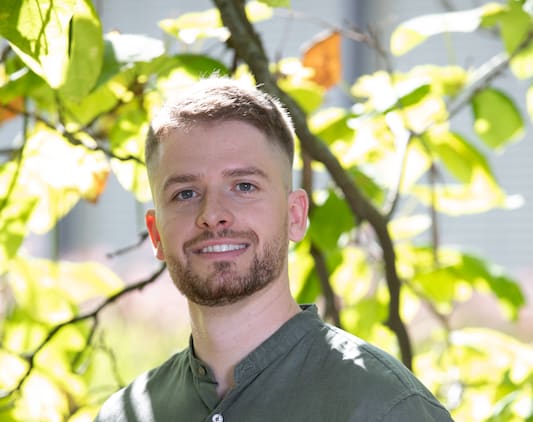
Portrait: Kalina Anguelova
Clément Meier looks you straight in the eye, and you immediately feel heard. Profoundly. He applies the same approach to research as he does to everyday life: he delves deeply into the human condition without superficiality. On the eve of a conference in Taiwan at which he’s due to receive an award, he compares his choice of research topic to simple maze games: “You know, when you can’t find a way out, you start at the end and work your way back.” He’s applied this method to public health. “I said to myself, ‘Why not start at the end?’” The end – by which he means death, preparations for it and the things left unsaid.
His research has earned him the PHPCI Early Career Research Award, which was presented to him at the Public Health Palliative Care International Conference in Taipei on 6–9 October 2026. “Just like the Olympic Games,” he explains, “this conference aims to leave its mark, helping the host city become a compassionate place where everyone supports the sick, the dying and their loved ones.” With reference to this year’s theme – “Bridging Culture, Building Compassion” – he says, “That’s exactly what I want to do.” Meier wants to observe how other cultures support people at the end of their life so that Switzerland – which he considers “far behind” in this respect – can benefit from his insight. Compassion lies at the heart of his research and the project he’s running with others at the Swiss Young Academy.
From economics to end-of-life care
Clément Meier first studied economics at HEC Lausanne. Drawn to the health sector, he wanted to understand “how the system works” before turning his attention to people’s health. Whilst studying for his master’s degree, he became a research assistant for SHARE, the major European survey on ageing. As an economist, he brings expertise in working with large databases.
After his master’s, a period of community service gave him time to reflect. He returned to research with a firm conviction: “I wanted to do something that would make a real impact.” One aspect of the SHARE data in particular caught his attention: what people know about death and end-of-life care. He made it the topic of his thesis, working within the framework of a newly established University of Lausanne (UNIL) doctoral programme at the intersection between medicine and social science. In December 2023, he became its first graduate.
Clément Meier likes a challenge. In 2024, he took part in “My thesis in 180 seconds”, where he summed up his work with a scene: a grandmother is out shopping when her heart stops. “What do you think are her chances of survival?” he asked. “Less than 8 percent.” In this case, as elsewhere, most of the 2,000 people aged 50 and over who were surveyed in the Swiss component of SHARE are mistaken. In Switzerland, one in three adults has limited skill in tracking down, understanding and using health information. And it’s precisely this group of people that is least likely to specify their healthcare wishes in case of an emergency. If a patient hasn’t expressed any wishes, the decision falls to his or her relatives and carers.
Dying surrounded by loved ones
Clément Meier discovered the role played by loved ones in his adolescence. When he was about 15, one of his brothers fell seriously ill, and Meier became a family carer. In this way, he discovered just how much the healthcare system relies on families, albeit “without involving them”. This experience convinced him that data alone isn’t enough. He therefore supplements it with qualitative and participatory approaches.
Within his family, which he describes as “extremely open and extremely loving”, people spoke openly about death and dying. Even so, dying remains a taboo subject in Switzerland. People there die in a very individual way, unlike in countries in which death is often a collective affair. Clément Meier says: “The dying need a lot of people around them. If not, they die alone and unhappy.”
First Buenos Aires, then London
To find out how things are done elsewhere, Meier spent six months in Argentina, from 2024 to 2025. During this time, he studied shared planning, which is similar to the Swiss anticipatory care planning project, but involves the family and carers to a much greater extent. He took part in workshops both in central Buenos Aires and in deprived neighbourhoods. “I was warned: don’t mention euthanasia. When you’re barely surviving, you can’t even imagine taking your own life.” But during a workshop, it was the very first thing that came up within the first five minutes. A woman who had seen her husband suffer terribly from cancer hoped that she would have that option one day in Argentina, even though she didn’t use the word “euthanasia”.
His second – more academic – stay took him to University College London for four months, from late 2025 to early 2026. Within the framework of SHARE, in Switzerland as elsewhere, when a participant dies, a close relative is interviewed about the deceased’s final months. However, this outdated questionnaire focuses mainly on the cost and type of treatment, and overlooks planning and social support. The British study recently added these factors, prompting a harmonisation project that draws on this to improve the European questionnaire.
A little nudge
For his next project, Meier was guided by a firm belief: small things, explained clearly, can bring about major changes. This is the principle of the “nudge”: a gentle reminder that provides guidance without forcing, such as fruit and vegetables placed at a child’s eye level in school canteens so that pupils are tempted to try them rather than choosing a dessert. Meier wants to apply this approach to end-of-life care in order to encourage everyone to prepare for it in their own way and help carers broach the subject. In November 2026, he submitted his Ambizione project. Currently dividing his time between HEC Lausanne, the Swiss Centre of Expertise in the Social Sciences (FORS) and the LIVES Centre, Meier knows that his future is uncertain. Without funding, he may have to cease his academic research. He could then see himself working at the Federal Office of Public Health (FOPH) or WHO, for a cantonal authority or even in politics. “But ideally, I’d like to continue my research.”
A voice for the next generation
Clément Meier has been a member of the Swiss Young Academy since 2024. He values its interdisciplinary projects, its outreach to the general public and its training programmes. Together with other members, he launched Compassionate Science. The idea extended his research into the importance of having people around you at the end. He wants to import the spirit of compassionate cities into the competitive world of academia.
Elected to the Executive Board for 2026–2027, he is its Speaker this year. “I think I’m a good representative because most young researchers are in the same situation as me,” he says. By which he means on short-term contracts and with a precarious future. He advocates for the budgets that support young academics because, as he puts it, “they are the source of innovation”. Meier believes that young people see science through the eyes of someone entering a house for the first time, noticing everything, from the location of the furniture to the colours of objects. “Asking questions and offering a different perspective – that’s what drives progress.”
His friends help him to unwind, relax and maintain balance. Since completing his PhD, he’s been engaging in sport three or four times a week. He enjoys travelling, partly to get an external perspective of Switzerland; a “bubble” in which you sometimes forget how fortunate you are. After all, a maze is best navigated with others.
December 2023: Graduates Doctor of Humanities and Social Sciences in Medicine and Health from the University of Lausanne. His thesis focuses on the health-related skills of older adults in Switzerland facing the end of their life.
2024: Elected a member of the Swiss Young Academy. Postdoctoral research at HEC Lausanne.
2024–2025: Six months in Argentina, where he studies shared care planning.
2025. Presented award by Federal Councillor Elisabeth Baume-Schneider at the National Palliative Care Conference.
Late 2025 to early 2026: Four months at University College London.
July 2026: His Ambizione project “Nudging the End of Life” is rejected. He resubmits it in November.
2026–2027: Executive Board Member and Speaker of the Swiss Young Academy.
October 2026: Receives the PHPCI Early Career Research Award in Taipei.
Today: Researcher at HEC Lausanne, affiliated with the Swiss Centre of Expertise in the Social Sciences (FORS) and the LIVES Centre.