

Blog
Swiss Young Academy SYA
“Female role models are a big topic in my discipline.”
As a child, Julia Venturini used to gaze at the night sky over Uruguay with her grandfather. Today, she simulates planet formation on computer clusters and chases planets with CHEOPS. Together with the Young Academy, she has conducted a survey on the reasons why young people leave an academic career. One of her findings was that women still have to fight harder.
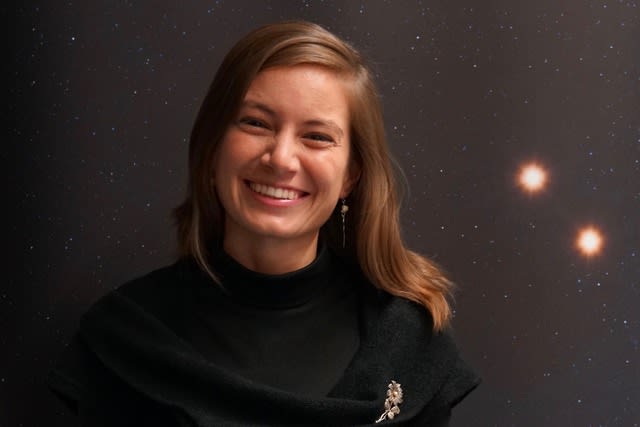
Interview: Astrid Tomczak-Plewka
Julia Venturini, which three qualities would you use to characterize yourself?
Curiosity, enthusiasm and leadership skills. I like coordinating science teams and take great pleasure in mentoring students.
You grew up in Uruguay and studied physics and astronomy there. Why did you choose these subjects?
As a child, I was simply fascinated by the stars. Uruguay has only three million inhabitants, and there are places where the sky is really dark. I often spent the summer holidays with my grandparents in a small village. The night sky there was really fascinating. It captivated me from an early age. I wanted to understand how stars work. And then I learnt about the first exoplanets– which further fuelled my curiosity. Much later, during an exchange programme in Argentina, I took a specialized course on exoplanets and thought: OK, I want to stick with this topic.
What role did your family background play?
Curiosity and a thirst for knowledge have always been present in my family. But as a natural scientist, I am something of a black sheep. My family tends to be more inclined towards the humanities. My mother is a literature teacher and writer, my brother has a PhD in literature, my grandfather was a lawyer, but he loved history – and astronomy. As a child, I often gazed at the sky with him.
The field is still very male-dominated, at least in Switzerland...
It’s similar in Uruguay, but as a student I didn’t feel it so much because the overall number of astronomers in my home country is so low. I mean, even in Uruguay, my professors were men. But in the early days, I just didn’t give it a thought.
It was only when I came to Switzerland that I realized how prevalent male dominance actually is, particularly in permanent positions. So it’s something that affects you more the higher you climb in the ladder.
You came to Bern in 2012 to do your PhD. The University of Bern has a good reputation in astrophysics – were there any other reasons?
I also wanted to experience living in another country. The actual opportunity arose through the Argentine researcher Andrea Fortier, who was teaching a course I took during my exchange programme in Argentina. She became a good friend, later moved to Bern as a postdoctoral researcher, and when a doctoral position became available there, she encouraged me to apply. That’s how I came to Bern.
What were your early days like in this city?
The culture is completely different, and the language is still a bit of a barrier for me. But I was able to do my PhD here in a field that really fascinates me – something I couldn’t have done in Uruguay.
Who has influenced you most in your career? Did you have any particular role models?
My first mentor in Uruguay, Tabaré Gallardo, was particularly important to me. He was an extremely good mentor who really cared about his students and their learning processes. I learned a lot from him, also about ethics – even very practical things, such as actually being present at conferences and not just taking a holiday.
Now Monika Lendl in Geneva is a role model for me. She is a young professor who leads teams calmly, respectfully and very clearly – which inspires me. Role models are a big topic in my field, as there are not many women.
You said at the beginning of the interview that leadership is one of your characteristics. What does leadership mean?
Really taking care of people. Being well-organized. Acting with respect. Keeping calm when something isn’t working, keeping a clear head to find a solution – and passing on that calmness to the team. It’s also important to recognize the team’s work so that people feel appreciated. You shouldn’t take people for granted. And of course, a key point is that you need a vision, a strategy: what is important, what comes next? It helps to pass on your enthusiasm for the cause.
What are you working on at the moment?
I’m working in the field of exoplanets. My specialist field is models of how planets form. We write numerical codes, solve equations and simulate how a planet grows in a disc around a star. From this, we derive predictions about what observers should see. There is always feedback between theory and observation. In Geneva, I am closer to observations, with missions such as CHEOPS and PLATO. With CHEOPS we measure the size of planets, and then we verify: do we see the trends that our models predict? In the Ambizione project, I focus on planets in binary star systems. It’s much more difficult for planets to form there. The second star disrupts the disc, the disc is cut off, there is less material – it’s an extreme environment. There are basically no global models for planet formation in binary star systems yet. We are currently developing them, and I’m proud of that.
Many people ask themselves: what does astronomy contribute to society? What is your reply?
These scientific questions drive the development of new technologies, which later find their way into everyday life. Digital cameras – like those found in every smartphone – were originally developed for astronomy. The same applies to many instruments that eventually find applications in medicine or security technology. We need to communicate better about these connections, so that people understand why fundamental research is important.
What was your motivation to apply to the Young Academy?
I am not just a scientist who sits at her models. I am interested in social problems and wanted to contribute to how science is communicated to society, how alternatives can be found when something is not working properly.
What do you gain from the discussions at the Young Academy?
I find it very enriching every time I attend a general assembly or a project meeting. You discuss with people from other disciplines who think differently and tackle different types of problems, and who bring another perspective to a joint project. I find that fascinating. And it confirms time and again that I’m in the right place, because interdisciplinarity is less marked in my normal astronomical environment than it is at the Young Academy.
You are the speaker for the project “Unveiling the Leaky Pipeline in STEM” (UPSTEM). What exactly do you do there?
I felt very alone in my specialist field when it came to gender inequality. I wanted to do something about it. At the Young Academy, I found others for whom this was also important – and that’s how UPSTEM came into being. There are many studies which show that more women than men leave science. But there were hardly any surveys in which the people who had left were actually interviewed. So, I thought to myself: why don’t we conduct a survey to find out first-hand why people left their academic careers and where they stand professionally today? That’s what we did.
What was the biggest challenge?
To find these people in the first place. When someone leaves a university, often no-one has their private e-mail address. Even the Swiss National Science Foundation only has institutional addresses, which are disabled at some point. In the end, we used the snowball method and, above all, LinkedIn. We received 205 replies. That’s not a lot, but it’s a start.
What do the first results show?
We were not really surprised with the results. The main reason for both men and women to leave academia is the lack of stability: short contracts, constant relocations. However, there are marked gender-specific differences with regard to discrimination and poor treatment, a lack of support or role models – women report this much more frequently than men. And when the reason given is “too few women in this field”, it’s almost exclusively women who mention this.
Have you also experienced this discrimination yourself?
That’s a delicate question… To be honest, I think so, but it’s very difficult to prove. It’s often subtle: who is accepted into certain circles, who receives information, who is invited? If you don’t know about opportunities, you miss them. And when it comes to hiring, I still see that men are given preference. The cliché that the brilliant person is the man is still with us. We women have to prove time and again that we are good. Prove, prove, prove – it’s exhausting.
What should UPSTEM achieve, ideally?
We have to present figures. Otherwise, everything will quickly be dismissed as anecdotal – “that’s your opinion, your experience”. With data, you can turn to the community, to political decision-makers and institutions, because only with data can you make policy. Then people must be willing to question their own prejudices and consider diversity as a core value. We also need men who are committed to equality – and that starts at home. If women take on the majority of care work, the system will not become equal.
You became a mother for the first time in 2019. How did you experience that period?
It was a very difficult time because you’re tired and don’t get much sleep. It becomes a real challenge to do creative, efficient work. At the same time, children completely change your life – it’s very demanding, but also incredibly rewarding.
And you need support. Let me be quite clear: anyone who pursues an academic career has to travel, go to conferences and attend meetings (all over Europe in my field). When you have children, things only work out if both parents really do their part – and not just in words. In our case, that requires a lot of organization. We have a large calendar in the kitchen. We look at it every morning to see who is doing what. This requires a lot of communication and takes energy, but there is no other way.
In conclusion: what message would you give to young people who are envisaging a career in science today?
Current times are hard. I am really worried. Budget cuts are exacerbating an already-difficult situation. There’s no clear career path in Switzerland; people move from one fellowship or grant to the next, and the prospects of success are basically like in a lottery. This makes it difficult to plan ahead and stay motivated. And if someone would like to start a family, this uncertainty becomes a major burden. Nevertheless, research is fascinating. We are working on new discoveries! So, follow your passion – but have a plan B. I tell my students: maybe do an internship in industry as well so that you keep doors open outside of academia.
Julia Venturini is an astrophysicist who researches how exoplanets form and evolve. She grew up in Uruguay, where she studied physics and astronomy, and came to the University of Bern in 2012 to do her PhD. After research stays in Zurich and at the International Space Science Institute (ISSI) in Bern, she received an SNSF Ambizione grant and now leads her own team at the University of Geneva. Her work is concerned with the development of numerical models for planet formation, with particular emphasis on planets in binary star systems, combining theory with data from space missions such as CHEOPS and, in the future, PLATO. Venturini is a member of the Swiss Young Academy. Within the Academy, she co-leads jointly with others the UPSTEM project – “Unveiling the Leaky Pipeline in STEM” – which investigates why researchers, particularly women, abandon their academic careers and what structural changes are necessary to prevent the loss of talent. She lives in Bern with her partner, a physics teacher, and is the mother of two children (born in 2019 and 2022). Her greatest passion outside of science is contemporary dance, which she has been practising for many years.